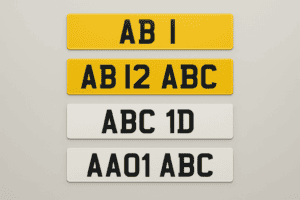
UK private number plates must follow formats set by the Driver and Vehicle Licensing Agency (DVLA). Two common systems appear on personalised registrations: the current system (also called the “new style”) and the older prefix system. Each format uses letters and numbers to show when a vehicle was first registered, which affects what a private plate can legally display. These rules help keep records consistent and support clear identification on the road.
The current system uses two letters, two numbers, then three letters, for example AB12 CDE. The first two letters identify the local registration office area. The two numbers form the age identifier. For March to August registrations, the number matches the year within the cycle (for example, 12 for 2012). For September to February registrations, the number increases by 50 (for example, 62 for September 2012 to February 2013). The final three letters act as a random sequence and do not carry a date meaning.
The prefix system places a single letter at the start, followed by up to three numbers and then three letters, for example A123 ABC. The initial letter indicates the registration period, with each letter assigned to a specific date range. Since the prefix letter signals age, a personalised plate in this style must not make a vehicle appear newer than the vehicle’s first registration date.
Spacing matters because it preserves the correct reading of the format. Drivers must not move characters to create a name or word if the result breaks the standard layout. The DVLA can withdraw a registration if spacing or character styling makes the plate hard to read or non-compliant. Police and ANPR cameras also rely on standard spacing to read plates accurately.
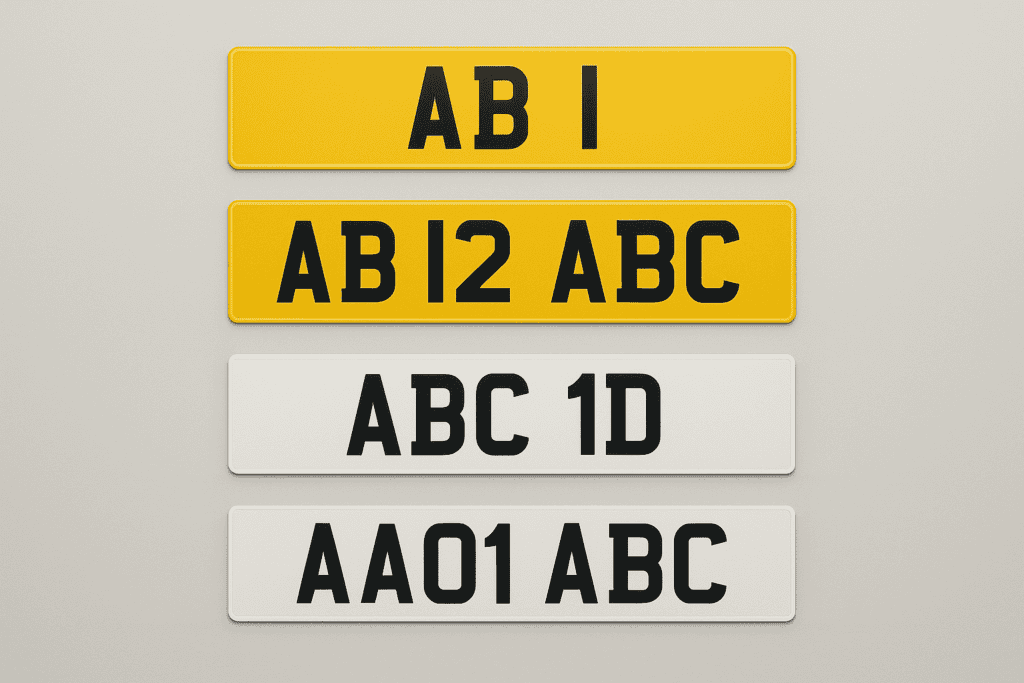
Age identifiers form the time marker within a UK registration and indicate when a vehicle was first registered, not when it was built. Under the current system, the two digits in the middle act as the age identifier. Codes from 01 to 49 relate to registrations issued between March and August in a given year, while codes from 51 to 99 relate to registrations issued between September and February. For example, 24 indicates March to August 2024, whereas 74 indicates September 2024 to February 2025. The DVLA uses this structure to keep registration records consistent across the UK.
A common misconception suggests that a private plate can make a vehicle appear newer. UK rules prevent that. You may assign a registration to a vehicle only if the age identifier does not make the vehicle look younger than its first registration date. As a result, a 74 plate cannot go on a vehicle first registered in 2019, even if the rest of the characters appear acceptable. The same principle applies when moving a plate between vehicles: the recipient vehicle must meet the age requirement.
Another frequent misunderstanding involves “cherished” or dateless registrations. Some personalised plates do not contain an obvious year code, which can make a vehicle appear older, but not newer. Drivers sometimes assume that any spacing or character arrangement can disguise the year code. Display rules do not allow that approach. You must show characters in the prescribed order and spacing, and you must not use fixings or stylised fonts to alter how the age identifier reads. Enforcement can lead to a failed MOT, a fine, or withdrawal of the registration.
UK law sets strict spacing and display rules so registration marks remain readable for enforcement and safety. The DVLA guidance on displaying number plates reflects the legal requirements that apply to private registrations in the same way as standard plates.
Spacing must follow the approved character grouping for the registration format. Under the current system, a space must sit between the first two letters and the age identifier, and another space must sit between the age identifier and the final three letters (for example, AB 24 CDE). Prefix and suffix formats also require a single space in the prescribed position. Drivers must not move, remove, or add spaces to create a name or word effect, since altered grouping can change how cameras and readers interpret the mark.
Font rules also apply. Plates must use the prescribed “Charles Wright” style, with fixed character height, width, and stroke thickness, plus minimum margins around the edge. Suppliers must not use italics, stylised lettering, shading, or decorative effects that reduce clarity. A plate must also show the British Standard reference and the supplier details, which helps confirm that the plate meets the required specification.
Prohibited layouts include stacked characters, uneven baselines, compressed spacing, or any arrangement that makes the mark appear as a different combination of letters and numbers. Fixings must not alter a character’s shape, such as turning a “P” into an “R”. Tinted covers and reflective films that impair legibility can also breach the rules. Police can issue penalties, and the DVLA can withdraw a registration if a driver persistently displays it incorrectly.
UK law sets clear display standards for number plates, and the rules apply to private registrations in the same way as standard marks. Plates must use a reflective surface to support visibility in poor light. The front plate must show a white background, while the rear plate must show a yellow background. Each plate must use black characters, and the characters must remain solid in colour without shading, patterns, or decorative effects.
Materials must meet the British Standard for number plates (BS AU 145e). That standard covers durability, reflectivity, and resistance to impact and weathering. Drivers should check that a supplier states compliance with BS AU 145e on the plate itself, since enforcement officers may treat missing or incorrect markings as a sign of a non-compliant plate. Guidance from the DVLA sets out the practical requirements that motorists must follow.
Plates must also carry specific marks. Each plate should display the British Standard reference (BS AU 145e) and the name and postcode of the plate supplier. Supplier details link the plate to a registered number plate supplier, which supports traceability and helps deter cloning. A plate may also show the manufacturer’s trade mark, provided the mark does not affect legibility.
Some optional identifiers remain lawful when used correctly. A national identifier, such as the UK identifier with the Union flag, may appear at the left side of the plate if it meets the prescribed design. Any symbol, badge, or text outside the permitted identifiers can make the plate illegal, even when the registration characters meet the spacing and font rules. Tinted covers, altered finishes, and stylised backgrounds also risk enforcement action because they can reduce reflectivity or interfere with automated number plate recognition.
Private registrations must suit the vehicle type as well as the plate format. The DVLA applies the same core rules to all vehicles, yet practical display requirements vary between cars, motorcycles, imports, and classics.
Cars must display a front and rear plate, each fixed securely and positioned so the full registration remains visible. Tinted covers, angled mounting intended to reduce legibility, and decorative surrounds that obscure characters can make a plate non-compliant. Any fixing bolts should not alter the appearance of a character, since enforcement cameras and roadside checks rely on clear shapes.
Motorcycles usually display a rear plate only. The plate still needs to meet the legal character size and spacing rules for motorcycles, which differ from cars. A common error involves fitting a smaller “show plate” to improve aesthetics. That approach risks a failed inspection and enforcement action if the plate does not meet the required dimensions and markings.
Imports can present extra constraints. Some vehicles have limited mounting space or a recessed plate area designed for non-UK dimensions. Even so, the registration must remain in an approved UK layout. If the vehicle cannot take a standard plate without modification, an owner should use a compliant plate size intended for the vehicle category rather than compressing spacing or using non-standard fonts.
Classics and historic vehicles can use traditional-looking plates in certain cases, yet eligibility depends on the vehicle’s age and registration details. Black and silver plates only apply where the vehicle meets the historic criteria, and the registration must still display correctly. Before ordering, confirm the vehicle’s status and permitted plate style using official guidance from GOV.UK.
Compliance affects more than appearance. Police and roadside cameras must read a registration quickly and accurately, so enforcement focuses on legibility and correct layout. During an MOT, testers check that number plates meet legal requirements for condition and display. A plate can fail if characters show damage, delamination, heavy staining, or cracking that makes the mark hard to read. Testers also reject plates that use non-standard fonts, incorrect spacing, or an obscured registration, even when the vehicle remains roadworthy in other respects.
Automatic Number Plate Recognition (ANPR) relies on consistent character shapes, contrast, and spacing. Mis-spaced characters, stylised fonts, tinted covers, and angled mounting can reduce camera accuracy and may trigger stops when a system cannot confirm a match. Drivers sometimes assume that a plate only needs to look readable to the human eye. Enforcement takes a stricter view because ANPR must work at speed, in poor weather, and at night.
When officers find a non-compliant plate, outcomes vary with severity and intent. Police may issue a warning, a fixed penalty, or a vehicle defect rectification notice that requires proof of correction within a set period. In more serious cases, officers can seize the plate and report the driver for prosecution. The GOV.UK guidance on displaying number plates summarises the core legal expectations, while the DVLA can withdraw a personalised registration if misuse persists. Losing the right to use a cherished mark can prove more costly than any fine, since the registration may return to the DVLA and the vehicle must revert to an age-appropriate number.
To reduce risk, drivers should treat plate compliance as a routine check, in the same way as tyres and lights. Clear, standard plates protect the registration’s value and prevent avoidable enforcement action.